
Low-wind start
Starts generating power at very low wind speeds.
The world's first wind-speed-adaptive, fully automated vertical axis wind turbine. It changes blade configuration with the wind: self-starting at 3 m/s and delivering full efficiency at high speed. No manual adjustment. No energy wasted.
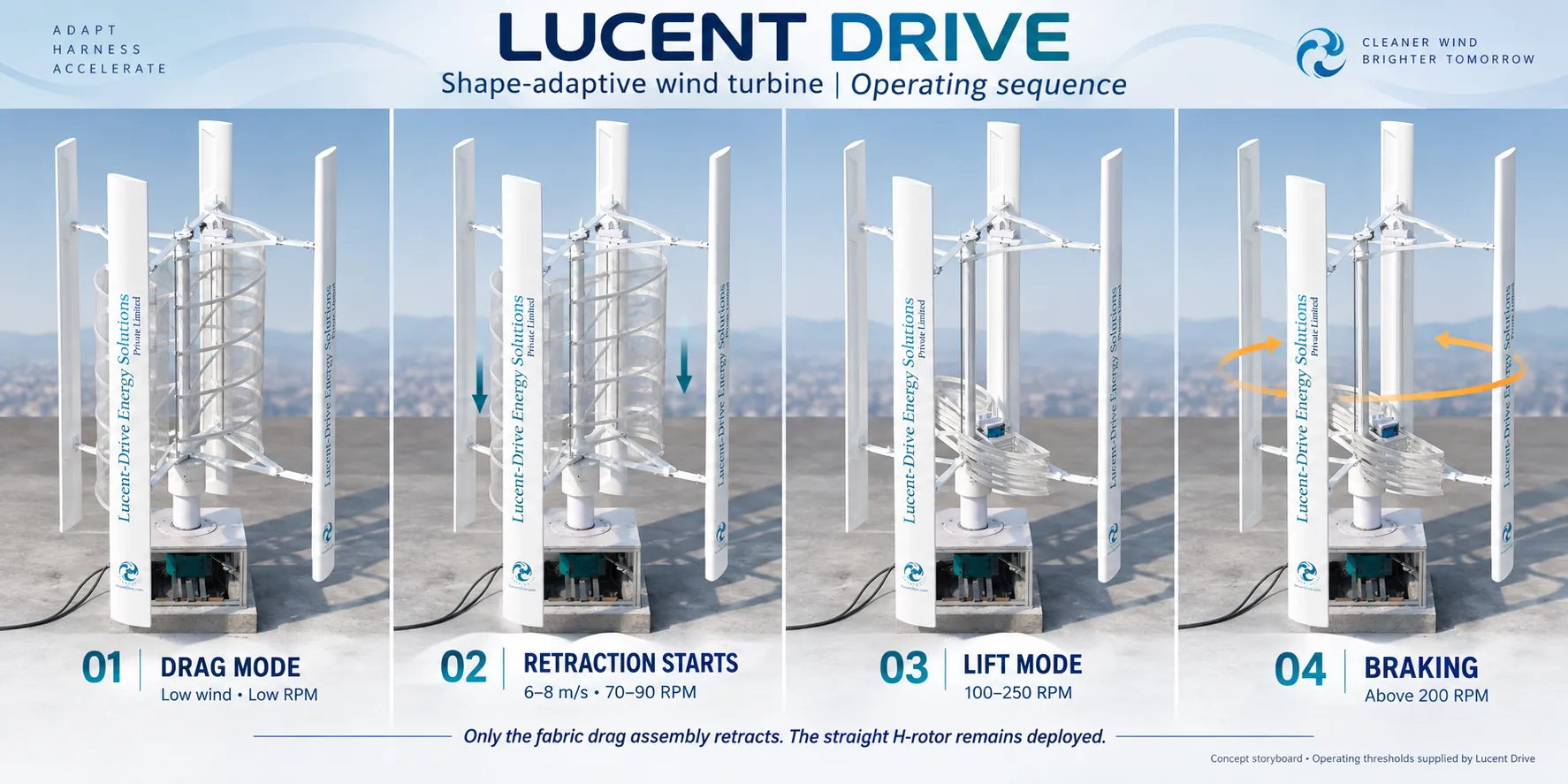
Drag the slider. At low wind the fabric drag assembly is fully open; at 6–8 m/s its frames slide down and the fabric folds away; in a storm the rotor is braked. The H-rotor blades never change. RPM thresholds are Lucent Drive design values; the animation speed is not to scale.
Design values. Installed flat-pack by two people in a day, with no crane, on about 8–10 m² of footprint.
A folding drag rotor inside fixed lift blades: drag where you need torque, lift where you need speed. The turbine keeps generating where conventional systems fall short.
The S-shaped drag rotor is fully unfolded for maximum area and high starting torque, so generation begins earlier in the day.
The frames slide down the shaft and the fabric folds away, cutting drag so the rotor accelerates quickly.
Four fixed H-rotor lift blades drive the rotor at speed, holding a stable rpm even in fast-changing urban wind.
When rpm falls the drag rotor unfolds automatically, ready to restart. Automated mechanical locking adds safety.
The drag (Savonius) rotor is an S-shaped spline formed by frames along the shaft with fabric between them. Fully open, it gives high starting torque at very low wind. At higher rpm the frames and fabric fold down, shrinking the drag area so the fixed lift (Darrieus) blades deliver peak efficiency. A perfect folding mechanism, from one controller.
Starts generating power at very low wind speeds.
Captures wind from any direction, no yaw alignment needed.
Frames and fabric retract down the shaft for faster acceleration and stability.
Less wear, less downtime, no lubrication schedule.
Lightweight, high strength, corrosion resistant and easy to install.
One controller drives the folding mechanism, connected to the cloud.
Intelligent control adapts to conditions for maximum output.
Handles icing, dust, overload and extreme weather.
Real-time data for proactive maintenance, plus regular software updates.
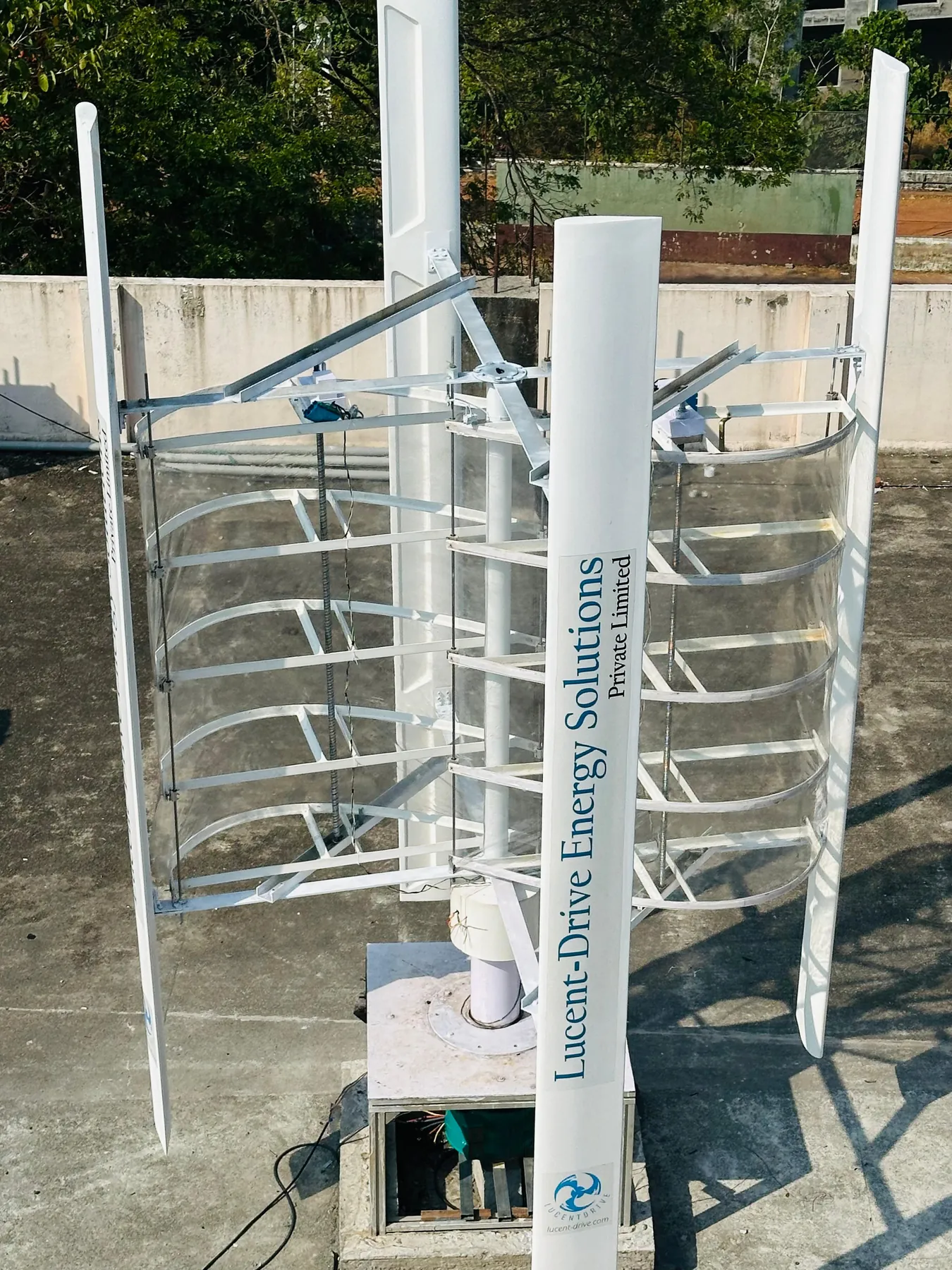
Founded in Kochi in 2022, patent filed in 2023, prototype completed in 2024 and pilots running since 2025. Pilot turbines run on a rooftop and on a high-wind ridge, and we are now preparing production and market launch.